Diversity, equity, and inclusion are principles in which I have always taken both pride and interest. In many ways, they are deeply personal to me and my family. Yet the values behind those words are not new to me. Respecting people, recognizing differences, and treating others with dignity were part of how I was raised, even though we did not call it DEI.
Throughout my career in veterinary medicine, I have seen why these principles matter. I entered the profession during an era when the veterinarian was still commonly assumed to be a white man. Over the years, I have watched veterinary medicine become more diverse in gender, race, background, and identity. That progress matters, but representation alone does not automatically create understanding or inclusion.
I have also learned that cultural differences extend far beyond what we can see. Every employee and client enters the clinic shaped by where they were raised, what they were taught, what they believe, and how they learned to communicate. Those influences appear in the language people use, the assumptions they make, and the ways they respond to authority, illness, money, grief, and conflict. Some beliefs are passed down through families and communities. Others develop through personal experience. All of them enter the clinic with us.
I have seen those differences surface in language that one person considers friendly and another experiences as disrespectful. In the South, terms of endearment such as “dear,” “sugar,” “darling,” or even “ladybug” can be part of ordinary conversation. They are often intended as warmth rather than condescension. However, someone who was not raised with that language may hear the same words very differently, particularly in a professional setting.
Neither reaction is necessarily dishonest. The speaker’s intention matters, but so does the effect on the person receiving it. Cultural awareness requires us to recognize that familiar language does not carry the same meaning for everyone. It also requires us to adjust when someone tells us that a particular term makes them uncomfortable. Respect should matter more than defending a habit.
I have witnessed more blatant forms of prejudice as well. I have seen clients refuse to see “the lady veterinarian” or “the Black veterinarian.” I have watched qualified veterinary professionals treated as though they must first prove they are good enough to belong in the profession. Their gender or race has nothing to do with the money they spent, the time they invested, the sacrifices they made, or the work required to earn their degrees and professional credentials.
A veterinarian should be evaluated by their knowledge, judgment, conduct, and quality of care. Requiring women and people of color to repeatedly prove qualifications that are readily assumed in others is not a harmless preference. It is discrimination, even when someone attempts to dress it up as tradition, familiarity, or personal comfort.
I have witnessed similar treatment toward LGBTQIA people, and I have felt it personally. Sometimes it is direct. Other times it appears through assumptions, jokes, guarded reactions, or the subtle change in someone’s behavior after learning who you are or whom you love. It can leave a person wondering whether they are being judged by their work and character or by an identity that has nothing to do with their ability to do the job.
There is also a difference between being tolerated and being included. Tolerance can mean that people permit you to remain present as long as you do not make them uncomfortable. Inclusion means that you do not have to hide your family, edit ordinary parts of your life, or continually determine whether it is safe to be honest about who you are.
My own experiences have made DEI more than a management concept for me. They have taught me how exhausting it can be to enter a room without knowing which version of yourself will be accepted. They have also made me more conscious of people whose differences may not be immediately visible. I cannot assume that my experiences are identical to theirs, but I can allow what I have lived through to make me more attentive, more willing to listen, and less likely to dismiss what another person tells me they have experienced.
I am fortunate to work with a team that accepts and supports me completely. We come from different generations, political backgrounds, religious beliefs, regions, and life experiences. We do not agree on everything, nor should we have to. Our workplace has shown me that inclusion does not require ideological conformity. It requires a shared standard of conduct and a commitment to treat one another with dignity.
The more difficult question is how a small, established veterinary practice carries that culture into the larger community.
Our clinic has served this community since 1975. That history carries weight. Generations of families have trusted it with animals they loved, often during some of the most vulnerable moments of their lives. Being part of an institution with that history means respecting what it has built. It also means accepting responsibility for what it becomes next.
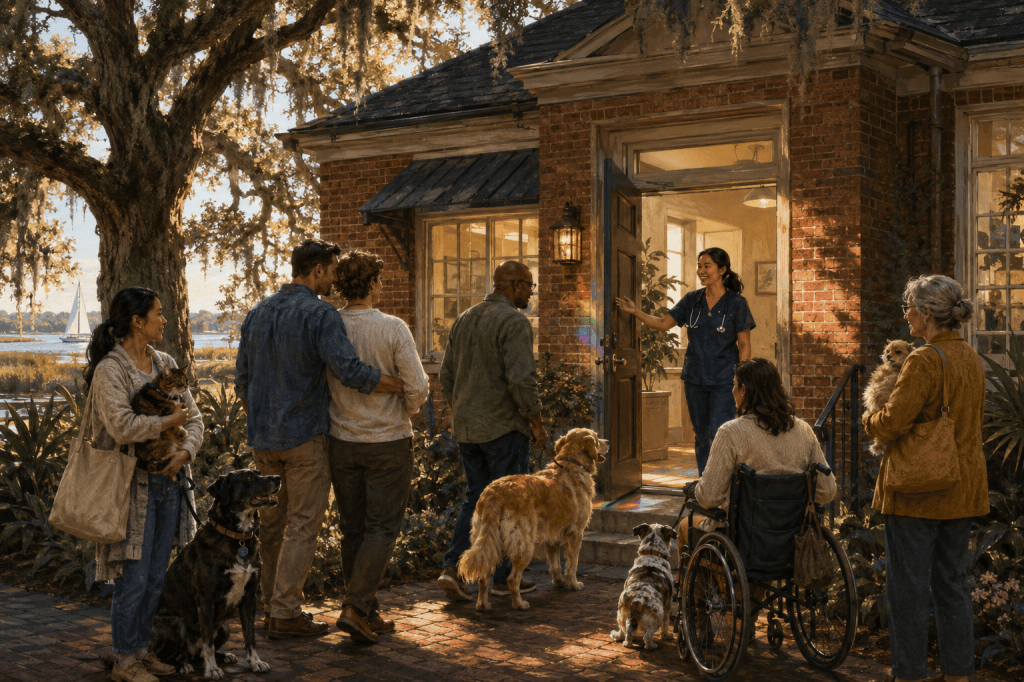
We serve people across the political, religious, and cultural spectrum. We want longtime clients to know they still belong here. We also want LGBTQIA people, different kinds of families, people with disabilities, religious minorities, and people from different cultures to know they belong here too. Those commitments should not compete with each other.
In a politically conservative community, even basic respect can sometimes be interpreted as taking sides. A rainbow sticker, an inclusive form, or the use of someone’s correct pronouns may be treated as a political declaration. That creates a temptation to remain quiet. Silence may avoid conflict, but it can also leave vulnerable people wondering whether they are safe.
Veterinary medicine does not need to become partisan to be inclusive. A transgender client should be addressed correctly. A same-sex couple should both be recognized as their pet’s family. A person with a disability should have meaningful access to care and communication. Cultural and religious differences may influence decisions about treatment, euthanasia, death, grief, and the handling of remains. Financial limitations should not be treated as moral failures. These are not campaign positions. They are matters of competent service and human dignity.
I also have to acknowledge my own struggle with tolerance. As I have grown older, I have found it increasingly difficult to remain patient with prejudice and with people who refuse to examine beliefs that harm others. Some of that response comes from years of experiencing criticism and judgment. Some reaches back to painful memories from childhood. Much of it comes from having lived long enough to watch society change while certain attitudes stubbornly remain.
I remember a time when LGBTQIA people were expected to remain quiet, conceal their relationships, and accept ridicule as part of life. I have watched laws change, families become more visible, and younger generations grow up with freedoms that many of us did not have. That progress proves that people and institutions can change. It also makes it harder for me to accept the claim that prejudice is simply a product of another time. We are all living in the present, whether we approve of it or not.
However, working for diversity and inclusion requires me to examine my own reactions too. Pain may explain why I respond strongly, but it does not automatically make every response useful. If I expect others to question what they were taught, I must remain willing to question myself. I do not have to tolerate discrimination, cruelty, or dehumanization. I do have to decide whether my goal is merely to condemn someone or to create an opportunity for better conduct.
That is one of the hardest parts of this work for me. Inclusion requires boundaries, but it also requires judgment. Some situations call for education. Others call for correction. A few require a firm refusal to allow harmful conduct to continue. Wisdom lies in recognizing the difference.
I know what I believe, but I am still learning how to translate those beliefs into policies, language, leadership, and community service. I do not want the clinic to abandon its roots. I want those roots to support a wider circle of people.
Preserving a community institution does not mean freezing it in the year it was founded. It means protecting the trust at its center and extending that trust to people who may not always have received it. That is the kind of progress I want to help build: not progress for appearance’s sake, but the steady work of making sure more people can walk through our doors and know that they belong.


Leave a comment